Festival at a Glance
- Location
- Buñol, Valencia, Spain
- Date
- Last Wednesday of August
- Duration
- 1 hour (tomato fight)
- Participation
- Ticketed, max 20,000
- Recognition
- Fiesta of International Tourist Interest (2002)
- Tomatoes used
- Approx. 150,000 kg annually
Origins and History
The first recorded tomato fight in Buñol occurred in August 1945 during the Giants and Big-Heads parade. A participant whose costume head fell off reportedly began hitting others, and bystanders nearby grabbed tomatoes from a market stall and joined in. The incident was ended by local police.
The following year a group of young men staged a planned re-enactment, bringing tomatoes from home. Police again broke it up, but the precedent was established. Through the late 1940s the event grew each year despite periodic police opposition.
In the early 1950s, Francisco Franco's government banned La Tomatina on the grounds that it lacked religious significance — an unusual criterion for a food fight. Participants continued anyway and were arrested on several occasions. In 1957, residents staged a symbolic "funeral procession" for the tomato, carrying a coffin through the streets accompanied by a brass band. The protest succeeded, and the festival was formally permitted.
By the 1980s and 1990s, international media coverage had turned La Tomatina into a global curiosity. Participant numbers climbed well beyond what the town's infrastructure could handle. In 2013, the local council introduced a ticketing system capping attendance at 20,000. In 2002, the Secretariat of Tourism declared it a Fiesta of International Tourist Interest.
Structure of the Day
The tomato fight itself runs for roughly one hour, but the day's programme begins significantly earlier. In the days preceding the Wednesday fight, Buñol organises a paella cooking contest, fireworks and musical performances in and around the town square.
The Palo Jabón
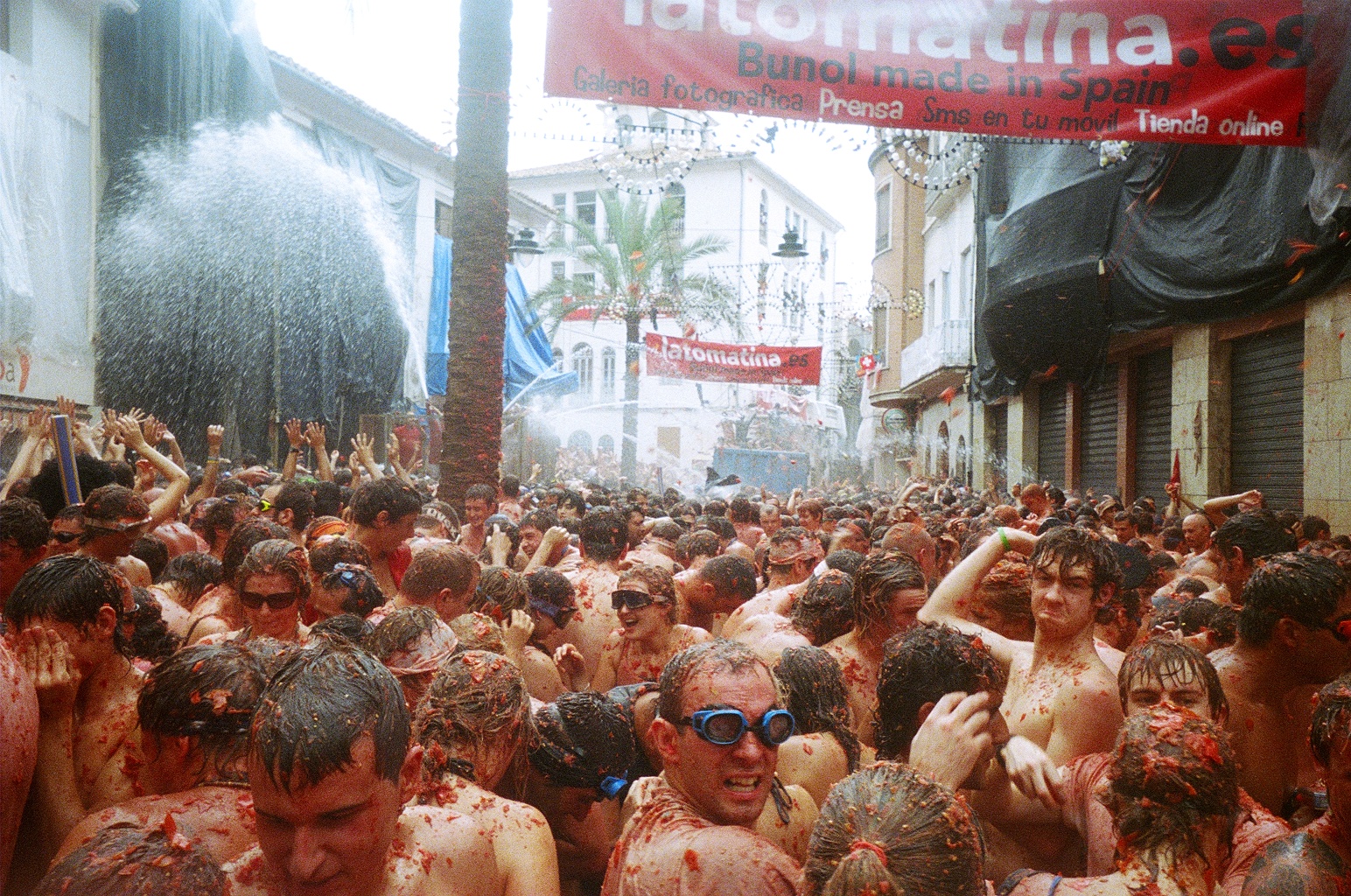
On the morning of the fight, the first scheduled event is the Palo Jabón — a tall, heavily greased pole with a cured ham tied to the top. The objective is for participants to climb the pole and knock the ham free. Groups form human ladders in repeated attempts while bystanders are doused with water from fire hoses. The tomato fight does not begin until the ham has been dislodged — or, if it has not, a signal shot is fired to begin on schedule.
The Fight
Tomato trucks enter the town square and adjacent streets. The fight begins with a signal and ends exactly one hour later with a second signal. Participants are expected to stop immediately when the signal sounds. Fire trucks then hose down the streets, and many participants head to the Los Peñones pool to wash off. The citric acid content of the tomatoes has a mild cleaning effect on the town's surfaces.
Rules and Safety
The local council issues an official rules list each year. The principal rules are:
- Throw only tomatoes — no other objects.
- Squash tomatoes before throwing to reduce impact force.
- Do not tear other participants' clothing.
- Maintain a safe distance from the trucks.
- Stop immediately when the second signal sounds.
- Follow instructions from security staff at all times.
Participants are advised to wear old clothing, eye protection and closed shoes. Bags and cameras can be left at supervised storage points near the town entrance.
Ticketing and Access
Since 2013, participation in the tomato fight requires a paid ticket. Tickets are sold through the official organiser, La Tomatina Tours, and several authorised resellers. The cap of 20,000 tickets typically sells out months in advance for popular years. Buñol's own population is approximately 9,000, meaning the festival multiplies the town's population significantly for one day.
Most visitors travel from Valencia, which is about 38 km away. Dedicated buses run on the morning of the event, and the town's train station also handles additional services. Accommodation in Buñol is very limited; most participants return to Valencia the same day.
Cultural Context
La Tomatina occupies an unusual position in Spain's festival landscape. Unlike the majority of major Spanish festivals, it has no religious origin, no civic or historical commemoration attached to it and no connection to the agricultural calendar (the tomatoes used are overripe and sourced specifically for the event, not from a local harvest). It is, in essence, a civic tradition that emerged from a spontaneous act and was institutionalised through repetition.
The festival has inspired similar events in other countries including Colombia, the United States and China, though none have the same historical continuity as Buñol's event.
Source: Spain.info — La Tomatina